Michael Hafftka
They Are Always Here
October 24 – December 19, 2026
Opening Reception: October 24, 6–9pm
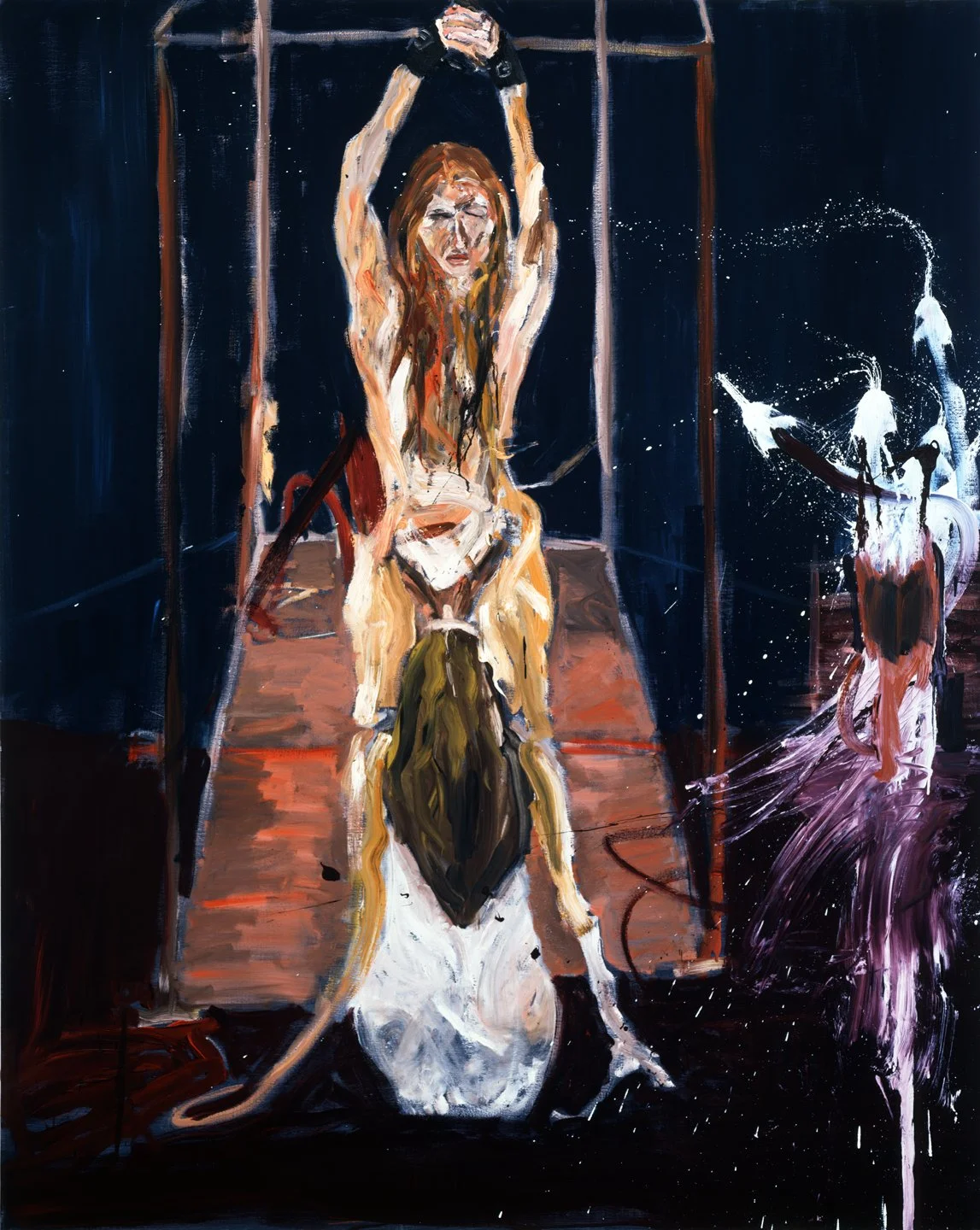
There are two kinds of people Michael Hafftka will lose in an instant with the painting on the invitation, and only one of them is lost because of the cunnilingus.
The other kind is lost at the face, done in six or seven strokes with the aesthetic of a child and the confidence of an adult. They will allow this distortion from a child, or a dead European, or Julian Schnabel. From a veteran painter they know only in passing, one who stands just outside the canon, their belief in their own taste has no life raft. They cannot tell clumsiness from conviction and will not be won over. They have not spent year after year failing into a gesture worth saving, or standing in front of a canvas deciding that an arm is too long for the world and exactly right for this painting.
So they fall back on what can be checked: the likeness, the perspective, the hours spent rendering a reality and a space they already recognize. They scan the room for someone of note who approves. Finding no one, they reach for a word like blasphemous, a strange word in so secular a milieu, though in front of this picture, titled Adoration, I suppose it is fair.
When he began showing in New York, a primal kind of figurative painting crept up through the floorboards like the sound of a nymphomaniac downstairs neighbor with unassailable tenants' rights. Nobody could explain it or evict it, since it had already died.
Hafftka has painted this way for fifty-three years. In that time, his pictures have thrilled people, moved them, unsettled them, left them cold or with a kind of bodily embarrassment, or worse—shame about their desires or their capacity for evil. He has gone on painting regardless.
Eventually, there was enough of this painting so it was sorted into movements by the people who do this kind of thing: "Bad" Painting, New Image Painting, Neo-Expressionism, each an answer to Minimalism and a repudiation of High Modernism's faith in abstraction. The differences that mattered a great deal then have now entirely dissolved. What is left are painters too singular and too free to be categorized.
The historians, blinded by their class, were still measuring by standards of endless refinement. Arbiters of taste could not register what was in front of them: one-person islands, each painter working out an entire view of the world on the principle that freedom counted for more than any measurable standard.
Younger painters are arriving there now: Robert Nava, Florian Krewer, painters who went to very good schools and came out painting as if they hadn't. They arrive for the reason Hafftka never left—it is where the child is. In his case, it is the child of Holocaust survivors who draws the monster in order to look at it, to imagine its horror, and who depicts primitive pleasure with the same hand.
A machine can now produce a convincing figure any number of times, and still it stumbles at the hands and feet, which is funny, because so do we. Fingers and toes have defeated painters for five hundred years. The best found a way around them, a hand tucked into a coat or a foot lost in shadow, or made the trouble itself expressive: a fist that is three strokes and a thumb. Hafftka shares with a handful of the best figurative painters working now the originality of the untrained child, the thing every art school exists to correct, which perseverance and a lifetime of looking at paintings have turned into a virtuosity of its own. A machine can copy the result, but it has no hand to get wrong and nothing to persevere with. What people find unforgivable in a painter like Hafftka is exactly what the machine lacks: that a person made the picture this way, by hand, on purpose, and stood by it.
— Kevin Tobin
Michael Hafftka (b. 1953, New York) lives and works in Brooklyn, New York. Hafftka’s work is in the Permanent Collections of the Metropolitan Museum of Art; the Museum of Modern Art; the Brooklyn Museum; the San Francisco Museum of Modern Art; Carnegie Museum of Art; the National Gallery of Art; the British Museum; among others.